text.skipToContent text.skipToNavigation

eBook: Electroporation

Get case studies, a poster, and an interview focused on practical electroporation insights. Download this eBook to learn how advanced electroporation approaches, such as Nucleofector® Technology, can help with hard-to-transfect cell types.

Watch Nucleofector® Technology in use

See how researchers use Nucleofector® Technology, e.g. in the field of CRISPR or CAR T cell screening.

Request more information

Interested in how Nucleofector® Technology can support your research needs? Request more information to learn more.  

What makes Nucleofector® Technology different?

Nucleofector® Technology transfers molecules directly into the cell’s nucleus. This approach does not depend on cell proliferation. As a result, you can transfect non-dividing primary cells, such as resting T cells or neurons.

Three components drive performance:

  1. Nucleofector®  System: The system uses unique electrical parameters to deliver substrates into the nucleus and the cytoplasm. It’s available in different formats to support small scale, high throughput and large scale experiments.
  2. Nucleofector®  Kits: Kits include dedicated vessels and solutions. The solutions create a protective environment that supports high efficiency and viability while keeping physiologically relevant conditions.
  3. Optimized protocols: Protocols give step-by-step guidance for optimal conditions. You can download optimized protocols from the Knowledge Center.


What to consider before implementing Nucleofector® Technology in your workflow


What is the basic principle of Nucleofector® Technology?

Nucleofector® Technology is a non-viral transfection method designed for primary cells and difficult-to-transfect cell lines. It combines electrical parameters with cell-type specific solutions. The method transports DNA directly into the nucleus. It also supports RNA and RNP delivery with high efficiency and high viability.


What is the advantage of Nucleofector® Technology over common electroporation (systems)?

Researchers value the combination of high viability and high efficiency. Nuclear delivery is especially important for non-dividing cells.


Why is the Nucleofector® Technology ideal for primary cells and difficult-to-transfect cell lines?

Direct nuclear delivery makes gene expression independent of cell division. This enables fast expression after transfection and can yield high efficiencies in many cases.


Can I use the Nucleofector® Technology for CRISPR and other genome editing applications?

Yes. You can apply the technology to CRISPR and other genome editing workflows. You can also download the Genome Editing Publication List or visit our dedicated genome editing page.


Need further support? Contact a transfection specialist to discuss your transfection challenges.

Get trusted guidance

Nucleofector® Platforms – Choosing the right system

Nucleofector® Platforms support different cell numbers and workflows. You can transfect cells in suspension or in adherent formats.

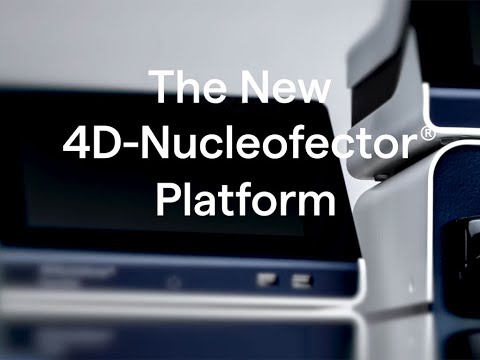
4D-Nucleofector® System

The 4D-Nucleofector® System combines a Core Unit with different functional units. This structure lets you match the setup to your application needs. Learn more below, or click on the image on the right to watch the video.


Have a specific application in mind? Share your research goals and we’ll pull together a quote for the system that’s best for your lab. 

Get a custom quote

4D-Nucleofector® Core Unit:
The controlling unit 
 

The 4D-Nucleofector® Core Unit controls the functional units. Use the touchscreen to define and save experiments, and connect units based on your workflow.

View product

4D-Nucleofector® X Unit: Transfecting various cell numbers in different formats

The 4D-Nucleofector® X Unit supports both 20 µL strip formats and 100 µL single vessels. You can transfer conditions seamlessly between these vessels and other units (for example, 96-well or 384-well formats).

View product

4D-Nucleofector® Y Unit: Adherent electroporation 
 

The 4D-Nucleofector® Y Unit supports adherent electroporation. It can help protect delicate primary cells such as neurons and maintain function while achieving up to 70% efficiency. To find out more, visit the 4D-Nucleofector® Y Unit product page.
 

View product

4D-Nucleofector® 96-well Unit: Increased throughput – 96-well transfection


Use the 4D-Nucleofector® 96-well Unit for screening, e.g. CRISPR screens, and optimization in a 96-well format. You can control each well independently across diverse primary cells and cell lines (10⁴–10⁶ cells per reaction). It also allows transfection in an automated workflow and even the transformation of bacteria and yeast. Learn more by visiting the 4D-Nucleofector® 96-well Unit page or watch our video about easy transfer of transfection conditions.

View product

4D-Nucleofector® LV Unit PRO: Next-generation large-scale electroporation


For large-scale transfection of up to 1 billion cells, this unit offers closed, sterile processing in volumes from 0.5 to 20 mL. Quickly translate research results into a GMP compliant cell therapy manufacturing process with GMP-grade TheraPEAK® Consumables, and a 21CFR part 11 compliant software and IQOQ services.

View product

384-well Nucleofector® System: High-throughput transfection in 384-well format 


Use this independent platform for fast, high-throughput transfection in 384-well plates for screening applications, including CRISPR Screens. Also, the system supports full integration into liquid handling systems. Find out more by visiting the 384-well Nucleofector® System product page or watch this video to see the 384-well HT Nucleofector® System in an automated setup.

View product

Emerging applications in transfection

Virtual event: Through a selection of four speaker sessions and a concluding panel discussion, you’ll discover latest transfection applications and receive tips and tricks from our experts.

Bioscience knowledge center

Browse our Cell and Transfection, Citation, FAQ and Culture Media Technical Databases.
 

References:

Byrne SM and Chruch GM. Crispr-mediated Gene Targeting of Human Induced Pluripotent Stem Cells Curr Protoc Stem Cell Biol 2015 35(Suppl 35):5A.8.1-5A.8.22

Georgiadis C, Rasaiyaah J, Gkazi SA, Preece R, Etuk A, Christi A, Qasim W. Base-edited CAR T cells for combinational therapy against T cell malignancies, Leukemia 2021 35(12):3466-3481

Kaji K, Norrby K, Paca A, Mileikovsky M, Mohseni P, Woltjen K. Virus-free induction of pluripotency and subsequent excision of reprogramming factors Nature 2009 458(7239):771-5

Maasho K, Marusina  A, Reynolds NM, Coligan JE, Borrego F. Efficient gene transfer into the human natural killer cell line, NKL, using the Amaxa nucleofection system Journal Immunol Methods 2004 284(1-2):133-40

Marques JT and Williams BRG. Activation of the mammalian immune system by siRNAs Nat Biotechnol 2005 23(11):1399-405

Monjezi R, Miskey C, Gogishvili T, Schleef M, Schmeer M, Einsele H, Ivics Z, Hudecek M. Enhanced CAR T-cell engineering using non-viral Sleeping Beauty transposition from minicircle vectors. Leukemia 201731(1):186-194

Roth TL, Li PJ, Blaeschke F, Nies JF, Apathy R, Mowery C, Yu R,  Nguyen MLT, Lee Y, Truong A, Hiatt J, Wu D, Nguyen DN, Goodman D, Bluestone JA, Ye CJ, Roybal K, Shifrut E, Marson A. Pooled Knockin Targeting for Genome Engineering of Cellular Immunotherapies,  Cell 2020 181(3):728-744.e21

Seki A and Rutz S. Optimized RNP transfection for highly efficient CRISPR/Cas9-mediated gene knockout in primary T cells J Exp Med 2018 215(3):985-997